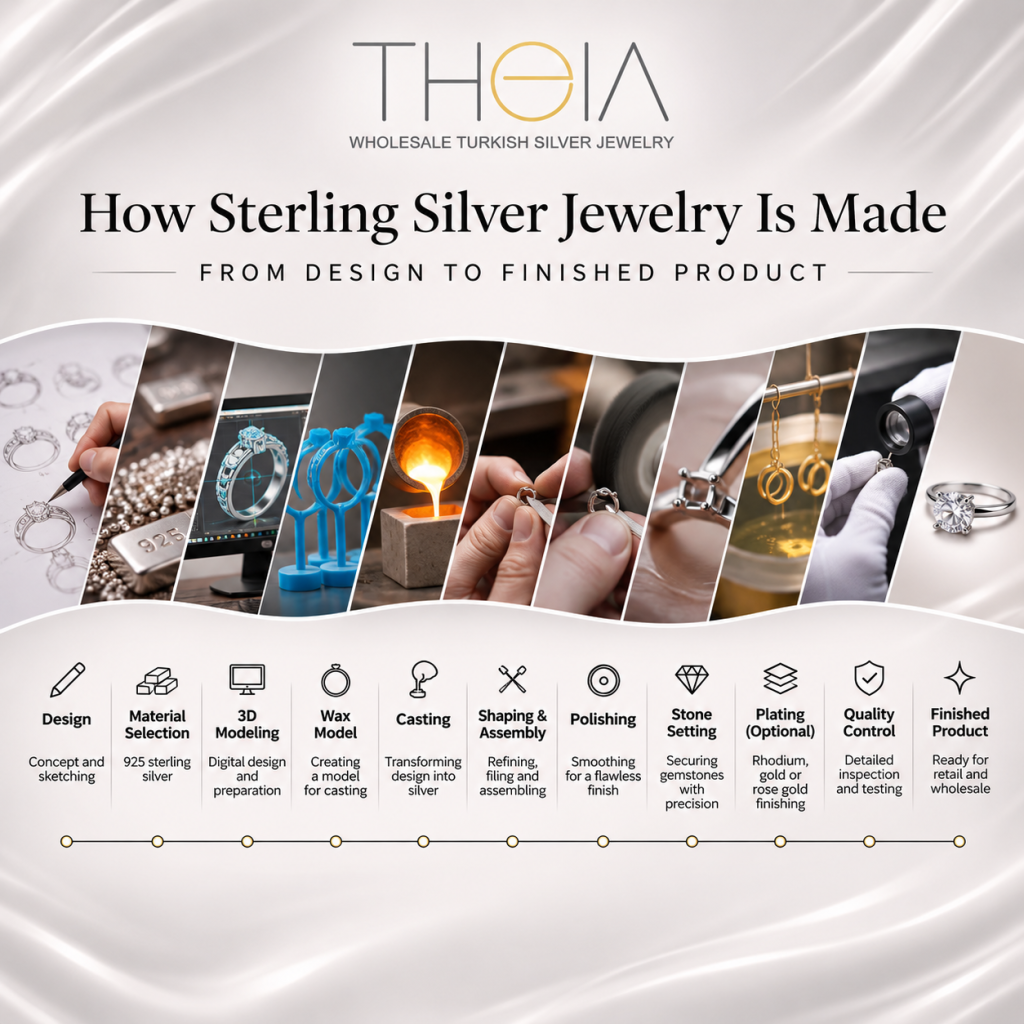
Have you ever wondered how a simple piece of silver becomes a beautifully finished ring, necklace, bracelet, or pair of earrings?
Behind every piece of sterling silver jewelry is a combination of design, technical expertise, skilled craftsmanship, and careful finishing. From the first design concept to the final quality inspection, each production stage contributes to the appearance, durability, and overall quality of the finished product.
925 sterling silver jewelry is particularly appreciated for its balance of beauty, versatility, and durability. Containing 92.5% pure silver and 7.5% other metals, typically copper, this alloy is widely used in contemporary jewelry manufacturing.
Understanding how sterling silver jewelry is made helps retailers, wholesalers, and jewelry enthusiasts appreciate the work and attention to detail behind every finished piece.
Let’s explore the complete process.
1. Jewelry Design: Where Every Piece Begins
Every jewelry piece starts with an idea.
Designers begin by developing concepts based on fashion trends, customer preferences, seasonal collections, and creative inspiration.
At this stage, important elements are considered:
- The overall shape and proportions
- The intended jewelry category
- Stone selection and placement, if applicable
- Metal thickness and structure
- Comfort and wearability
- Surface details and finishing style
Modern jewelry design often combines traditional inspiration with contemporary techniques.
Depending on the complexity of the piece, designers may create hand-drawn sketches, technical drawings, or digital 3D models before moving into production.
A carefully developed design provides the foundation for the entire manufacturing process.
2. Selecting the Right 925 Sterling Silver Material
Material quality is one of the most important aspects of silver jewelry production.
Sterling silver is an alloy containing:
- 92.5% pure silver
- 7.5% other metals, commonly copper
Pure silver is relatively soft, making it less suitable for many everyday jewelry applications. The addition of other metals improves its mechanical strength and helps make it more practical for manufacturing.
Using the correct silver alloy is essential for producing jewelry with consistent quality and reliable performance.
For manufacturers and wholesalers, material selection also plays an important role in maintaining product consistency across collections.
3. Creating the Jewelry Model
Once the design is finalized, the next step is creating a physical or digital model.
Depending on the manufacturing method, this may involve:
Traditional Model Making
Experienced artisans can create models by hand, shaping and refining the design before production.
3D Jewelry Modeling
Computer-aided design (CAD) software allows designers to build detailed three-dimensional models.
These models help manufacturers evaluate proportions, dimensions, stone settings, and structural details before creating the final piece.
3D Printing and Wax Models
In many modern production processes, a 3D-printed wax or resin model is used to prepare the casting mold.
This stage helps translate a digital design into a physical manufacturing model.
4. Silver Casting: Transforming Metal into Shape
Casting is a widely used method for producing sterling silver jewelry, particularly for designs with detailed shapes and complex structures.
One common technique is lost-wax casting.
The process generally involves:
- Creating a wax or suitable resin model.
- Placing the model inside a casting flask.
- Filling the flask with investment material.
- Heating it to remove the wax or model material.
- Pouring molten sterling silver into the resulting cavity.
- Allowing the metal to cool before removing the investment material.
The result is a silver casting that follows the original design.
After casting, the pieces are carefully removed, and excess material is trimmed away.
Not every silver jewelry item is manufactured through casting. Chains, sheet-metal designs, and certain handcrafted components may require different forming and assembly techniques.
5. Cutting, Shaping, and Assembly
After casting or forming, the jewelry moves into the shaping and assembly stage.
At this point, artisans refine the individual components and prepare them for final construction.
Depending on the design, the process may include:
- Trimming excess metal
- Filing and smoothing edges
- Bending and shaping components
- Soldering separate parts together
- Attaching clasps, chains, and connectors
- Preparing settings for gemstones
This stage requires precision because small structural details can influence the comfort, appearance, and durability of the finished jewelry.
For example, a ring must have a consistent shape and comfortable inner surface, while an earring needs carefully aligned components.
6. Stone Setting and Decorative Details
For jewelry designs featuring gemstones or decorative elements, stone setting is an important production stage.
Depending on the design, stones may be secured using different techniques:
Prong Setting: Small metal prongs hold the stone in place while allowing light to enter.
Bezel Setting: A surrounding metal rim secures the stone and creates a clean, refined appearance.
Pavé Setting: Small stones are placed closely together to create a continuous decorative surface.
Channel Setting: Stones are positioned within a metal channel for a smooth and structured finish.
The setting method depends on the stone type, design, dimensions, and intended appearance.
Accurate stone placement is essential for both visual balance and secure construction.
7. Polishing and Surface Finishing
Polishing is one of the most noticeable stages in sterling silver jewelry manufacturing.
After shaping and assembly, the surface may contain small marks, rough areas, or imperfections that need to be refined.
Different finishing techniques create different visual effects.
High-Polish Finish
Creates a smooth, reflective surface that highlights the natural brightness of sterling silver.
Matte Finish
Produces a softer, less reflective appearance for a contemporary aesthetic.
Brushed Finish
Creates subtle linear textures across the metal surface.
Oxidized Finish
Uses controlled surface treatment to create darker details and emphasize design depth.
Careful finishing helps bring out the character of each jewelry design.
8. Plating and Color Finishing
Some sterling silver jewelry pieces receive an additional surface treatment to achieve a particular color or finish.
Common options include:
Rhodium Plating
Rhodium plating provides a bright, silvery-white appearance and can help improve surface resistance to tarnishing.
Gold Plating
Gold plating gives sterling silver a warm gold-colored appearance, offering an alternative aesthetic while retaining the underlying silver base.
Rose Gold Plating
Rose gold plating creates a softer, warmer tone with a distinctive pinkish appearance.
The choice of plating depends on the design, target market, and desired product finish.
Plating is a surface treatment and does not change the underlying 925 sterling silver composition.
9. Final Quality Control and Inspection
Before jewelry reaches retailers or customers, it should undergo a final inspection.
Quality control helps ensure that each piece meets the required production and finishing standards.
Important inspection points include:
- Overall shape and symmetry
- Surface quality and polishing
- Soldering and component connections
- Stone placement and security
- Clasp and fastening functionality
- Plating consistency, where applicable
- Appropriate 925 silver identification and material verification
Reliable quality control is particularly important for wholesale jewelry businesses because consistency across multiple pieces is essential.
A well-inspected product helps retailers maintain customer confidence and build a strong reputation.
10. The Finished Product: Ready for the Market
After completing production and quality inspection, the jewelry is prepared for packaging and distribution.
Finished sterling silver jewelry may be organized by product category, collection, size, color, or design.
For wholesale businesses, accurate product information and professional product photography are also important parts of presenting the finished collection.
Clear product images, consistent descriptions, and organized catalogs help retailers evaluate products and make purchasing decisions more efficiently.
From a delicate silver necklace to a detailed gemstone ring, every finished piece represents the combined effort of design, material selection, manufacturing, and finishing.
Why Manufacturing Quality Matters in Wholesale Sterling Silver Jewelry
For retailers and jewelry businesses, understanding the manufacturing process is more than an interesting detail.
It helps buyers make informed decisions when selecting wholesale suppliers.
When evaluating a sterling silver jewelry collection, businesses should consider:
- Verified 925 sterling silver composition
- Consistent manufacturing standards
- Reliable finishing and craftsmanship
- Secure gemstone settings
- Consistent plating quality
- Accurate product descriptions
- Professional product presentation
Choosing a wholesale supplier that prioritizes product quality and consistency can help businesses develop stronger and more reliable jewelry collections.
Discover 925 Sterling Silver Jewelry with Theia Silver
Every beautiful jewelry piece begins with thoughtful design and attention to detail.
At Theia Silver, we focus on 925 sterling silver jewelry designed for businesses seeking contemporary styles, versatile collections, and refined aesthetics.
From minimalist everyday designs to gemstone-inspired pieces, our wholesale collections bring together different styles for modern jewelry retailers.
Whether you are expanding an existing collection or sourcing new designs for your business, explore Theia Silver and discover our range of wholesale 925 sterling silver jewelry.
Theia Silver – Timeless Designs. Sterling Silver Quality.
Frequently Asked Questions (FAQ)
What does 925 sterling silver mean?
925 sterling silver contains 92.5% pure silver and 7.5% other metals, typically copper. This composition provides greater strength than pure silver.
How long does it take to manufacture sterling silver jewelry?
Production time varies depending on the design, manufacturing technique, complexity, and production volume. Simple pieces may require fewer production stages than detailed gemstone jewelry.
Is all sterling silver jewelry made using casting?
No. Casting is one common manufacturing method, but sterling silver jewelry can also be produced using sheet metal forming, wirework, chain assembly, and traditional handcrafting techniques.
Why is polishing important in silver jewelry production?
Polishing improves surface smoothness and appearance while helping reveal the natural shine of silver. Different finishing techniques can also create matte, brushed, or textured effects.
Can 925 sterling silver jewelry be gold plated?
Yes. Sterling silver can receive gold plating or rose gold plating to achieve different surface colors while retaining its sterling silver base.
Explore Theia Silver’s wholesale 925 sterling silver jewelry collections.
www.theiasilver.com